 One of the hardest conversations in real estate happens when a homeowner believes their property is worth considerably more than the price their real estate agent recommends.
It is understandable.
Your home is not just a collection of bedrooms, bathrooms, square footage, and finishes. It may be where you raised your children, celebrated holidays, completed years of improvements, and made memories that cannot be assigned a dollar value.
But when it is time to sell, there is an important distinction:
What your home is worth to you and what buyers are willing to pay for it are not necessarily the same number.
Is My Real Estate Agent Trying to Underprice My Home?
Usually, the better question is:
What evidence supports the recommended listing price?
A well-prepared real estate agent should be able to explain the pricing recommendation using actual market data rather than simply giving you a number.
A Comparative Market Analysis, commonly called a CMA, typically considers factors such as:
-
Recently sold comparable homes
-
Homes currently under contract
-
Active listings competing for the same buyers
-
Location and neighborhood
-
Square footage and floor plan
-
Lot characteristics
-
Age and condition
-
Renovations and updates
-
Features buyers currently value
-
Days on market
-
Seller concessions
-
Current supply and buyer demand
The National Association of Realtors® explains that comparable properties that have recently sold, are under contract, or are currently active can all be used when preparing a CMA and developing a recommended listing price.
That last category, active competition, is especially important.
A home does not compete only with properties that sold three or six months ago. It also competes with the homes a buyer can tour and purchase today.
Market Value Is Not the Same as What You Have Invested
This is one of the most difficult concepts for sellers.
You may have spent $75,000 remodeling your kitchen, $25,000 replacing windows, $20,000 landscaping the backyard, and thousands more on flooring, paint, lighting, HVAC systems, and other improvements.
Those improvements may absolutely make your home more desirable.
But buyers do not generally calculate value by adding up everything you have spent.
Some improvements may provide a strong return.
Others may help your home sell faster without returning their full cost.
And some improvements may have been primarily for your own enjoyment.
Cost and market value are not the same thing.
A buyer is comparing your home with the other homes available within that buyer’s price range.
Sellers and Buyers See the Same House Differently
Homeowners naturally become accustomed to their surroundings.
You may barely notice the carpet that needs replacing, an older bathroom, crowded countertops, dated fixtures, or landscaping that has become overgrown.
A buyer sees those things immediately because the buyer has no emotional attachment to the property.
That does not mean your home is undesirable.
It simply means a buyer is evaluating it differently.
Buyers are asking:
“What can I purchase for this amount of money?”
They may compare your home with a recently renovated property, new construction, a home with a larger lot, or another house offering a seller concession.
That comparison ultimately influences what they are willing to offer.
Can a Home Be Priced Too Low?
Yes.
An agent can make a pricing mistake.
That is exactly why sellers should never accept a recommended listing price without understanding how the agent arrived at it.
Ask to see the comparable sales.
Ask why certain homes were included and others were excluded.
Ask how condition and updates were considered.
Ask what competing homes buyers will see alongside yours.
Ask whether seller concessions affected recent comparable sales.
And ask the agent to explain what has happened in your specific price range and neighborhood.
You should be able to follow the reasoning.
A professional pricing recommendation should be based on market evidence, not intuition.
But Pricing Higher Does Not Automatically Mean You Will Make More Money
This is where sellers can unintentionally hurt themselves.
Suppose the market evidence suggests a home’s likely value is around $700,000, but the seller decides to list at $775,000 because they want to “leave room to negotiate.”
The problem is that buyers do not necessarily start at $775,000 and negotiate downward.
Some may simply eliminate the property from consideration.
Others may choose a competing home they believe offers a better value.
The seller can then lose valuable market time before eventually reducing the price.
A higher initial asking price is not automatically a stronger negotiating strategy.
The goal is not to obtain the highest listing price. The goal is to achieve the strongest realistic sale price and terms the market will support.
What Does an Appraisal Tell You?
An appraisal is different from a CMA.
An appraisal is an independent opinion of value performed by a licensed or certified appraiser for a specific purpose. In a financed transaction, lenders commonly use an appraisal or another permitted valuation method when evaluating the property securing the loan.
The Consumer Financial Protection Bureau explains that appraisal values are generally developed by comparing a property with comparable local sales and making adjustments for differences between the properties.
But an appraisal should not be described as the final or absolute truth about what a home is worth.
It is an opinion of value as of a particular date and for a particular intended use.
Different valuations can sometimes produce different results because they may use different comparable properties, different information, or be completed at different times. The CFPB specifically notes that different valuation methods can result in different estimates.
What If I Still Believe My Home Is Worth More?
Then I believe you should ask for the evidence.
A good listing consultation should never feel like:
“Trust me. This is what your house is worth.”
Instead, it should be:
“Here is what has sold. Here is what is currently competing with you. Here is what buyers have been willing to pay. Here are the differences between those properties and yours. Now let’s determine the pricing strategy that best supports your goals.”
If the property is particularly unusual, difficult to compare, or the seller and agent remain far apart on value, obtaining an independent pre-listing appraisal may also be worth considering.
Your Listing Price Is a Marketing Decision
This is an important distinction.
Market value and listing price are related, but they are not necessarily identical.
The listing price is part of the property’s marketing strategy.
Depending on the seller’s goals and current market conditions, there may be legitimate reasons to price:
-
Very close to the estimated market value
-
Aggressively to generate greater buyer interest
-
At a strategic search threshold
-
Slightly above the expected sale range when supported by the market
NAR notes that a seller’s goals and timeline can influence pricing strategy. A seller seeking a faster sale may choose more competitive pricing, while a seller with greater flexibility may take a different approach.
What I would avoid is choosing a price simply because it is the number a seller hopes to receive.
Hope is not a pricing strategy.
So, Did Your Agent Underprice Your Home?
Maybe.
But you cannot answer that question simply by comparing the recommended price with the number you had in mind.
Look at the evidence.
Look at the most relevant recent sales.
Look at the homes currently competing for the same buyers.
Look at pending sales when reliable information is available.
Look carefully at condition, location, lot, updates, floor plan, age, concessions, and current buyer demand.
Then ask whether your agent can clearly explain how all of those factors led to the recommended price.
That is the conversation that matters.
FAQ:
How do I know if my real estate agent underpriced my home?
Review the comparable sales, current competing listings, pending sales when available, property condition, location, updates, and current buyer demand that were used to establish the recommended price. Your agent should be able to explain how the market data supports the pricing recommendation.
How does a Realtor determine what my home is worth?
A real estate professional typically prepares a Comparative Market Analysis using relevant recently sold homes, active listings, pending properties, and characteristics of the subject property. Location, condition, size, amenities, market conditions, and seller goals can also influence the recommended listing strategy.
Is a CMA the same as an appraisal?
No. A Comparative Market Analysis is generally prepared by a real estate professional to help a buyer or seller evaluate pricing. An appraisal is an independent professional opinion of value prepared by a licensed or certified appraiser for a particular intended use.
Does listing my home higher mean I will sell it for more money?
Not necessarily. Buyers compare your property with other homes available within their price range. An asking price that is not supported by the market may reduce buyer interest and increase market time rather than produce a higher sale price.
Do home improvements increase my home’s value dollar for dollar?
Usually not. Improvements can affect desirability and market value, but the amount spent on an improvement does not automatically equal the amount it adds to the home’s resale value.
Can an appraisal and CMA have different values?
Yes. Valuations are estimates and may rely on different comparable properties, information, methodologies, or valuation dates. The CFPB notes that different types of valuations can produce different results.
What is the best way to determine my Cumming GA home’s value?
Start with a property-specific analysis of relevant recent sales, current competition, pending activity when available, location, condition, improvements, lot characteristics, and current buyer demand. Online estimates can be useful as a starting point, but they may not account for important property-specific differences.
Thinking About Selling a Home near North Fulton or Forsyth County?
Before deciding what your home is worth, I believe you should understand why the market is supporting that value.
My pricing analysis looks beyond a simple price-per-square-foot calculation. I evaluate recent comparable sales, current competition, buyer activity, property condition and features, neighborhood trends, and the factors most likely to affect how today’s buyers will compare your home with other available properties.
If you’re thinking about selling your home in Cumming, Forsyth County, Alpharetta, Milton, Johns Creek, Suwanee, or the surrounding North Georgia area, I would be happy to prepare a complimentary Comparative Market Analysis and walk you through the numbers.
The goal isn’t to tell you what you want to hear. It is to give you the information you need to make a smart selling decision.
This article is provided for general real estate information. A Comparative Market Analysis is not an appraisal. Property values, market conditions, financing requirements, and individual circumstances vary.
This Local Real Estate blog is hosted by Gayle Barton, a top producing Realtor® with BERKSHIRE HATHAWAY HomeServices Georgia Properties. Gayle Barton is an award-winning agent ranked among the top 6% of BHHS agents nationwide. Licensed since 1983, she brings significant experience in negotiation and client advocacy and has closed more than $100 million in local sales.
Gayle specializes in real estate sales in the following North Georgia Counties – Forsyth, North Fulton, Dawson, East Cherokee, – Cities: Cumming GA, Suwanee GA, Alpharetta GA, Milton GA, Johns Creek GA, Ball Ground GA, Big Canoe GA, Dawsonville GA
Meet Gayle Barton Forsyth County Real Estate | Gayle Barton Google Business Profile | Barton Team Real Estate
Disclaimer: Information contained in this post is deemed reliable on the date of publication, but it is not guaranteed, and it is subject to change without notice. All content, including text, original art, photographs and images, is the exclusive property of Gayle Barton and may not be used without expressed written permission.

 One of the most important decisions you will make when selling your home is where to price it.
 You just received an offer on your home and you are ecstatic…. until you look at it closely and see that the offer amount is significantly lower than your asking price. How should you respond?
 When I begin working with a homeowner to determine the right pricing strategy for their home, my first step is to complete a comprehensive Comparative Market Analysis, also known as a CMA.


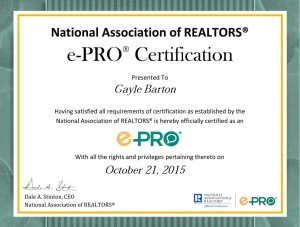 With over 90% of all buyers starting their home search online, an understanding of online marketing has never been more important! As a nationally recognized e-PRO certified agent, I have both the training and experience to take your listing to the next level.
 We don’t just say what we’re going to do… WE PUT IN WRITING! The use of our

 My clients needs are my number one priority and putting them first is how I distinguish myself from other agents in my area.